
Digitization has been an important strategy for Starbucks’ global growth. As early as 2016, Starbucks proposed the “digital flywheel” strategy (Dignan, 2017). Through AI technology and big data analysis to understand user needs, Starbucks maximizes and optimizes user experience, and can develop new products based on consumption data and use them in business decisions such as site selection. Specifically, it involves four modules: Starbucks membership system, mobile payment, personalized experience and mobile purchase experience.
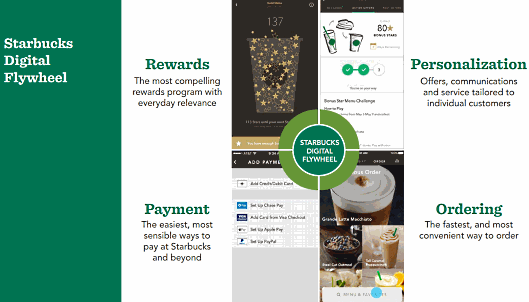
In the Chinese market, Starbucks entered Taiwan in 1998 and mainland China in the following year. By 2018, there were over 3500 stores in China (Statista, 2020). Despite the rapid growth of Starbucks’ business and the popularity of the “third space” concept, Starbucks still has shortcomings in personalized experience and mobile purchase experience. In 2019, Starbucks China adjusted its management structure, digital innovation division and retail division in line with the “digital flywheel” strategy.
Module 1: Rewards
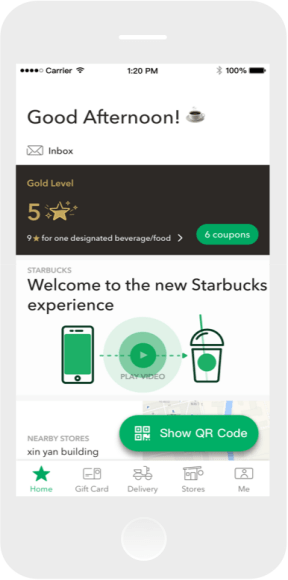
The membership system of Starbucks mainly sets members at three different levels, and trains users’ usage habits and improves loyalty through continuous membership rights and membership fluctuation mechanism. Loyalty membership program not only promotes users’ consumption in Starbucks, but also improves users’ retention rate and lifetime value. In China, consumers only need to buy a membership card to register on the application in one minute and enjoy benefits. Membership points are calculated by the simplest “Star”. If people spend ¥50, they can get a star. When people have 4 stars, their membership rights can be upgraded to Green Tier. And 20 stars can make them achieve Gold Tier (Starbucks China, 2020). Users can view the number and level of stars on the application at any time. Membership upgrade system is easy to understand.
Module 2: Payment
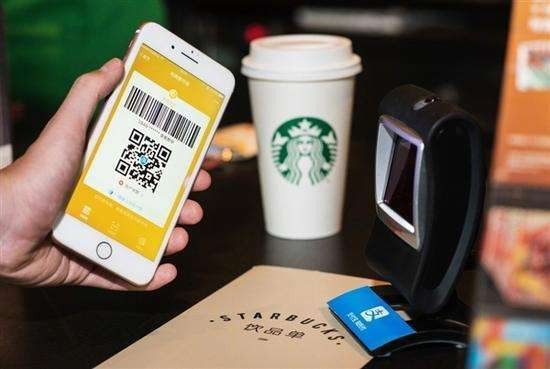
In 2011, Starbucks launched the mobile payment function. As the “third space” behind family and work, customers can enjoy a very pleasant experience through Starbucks wallet. This wallet can be connected to credit card, Apple Pay, PayPal, etc. More importantly, the wallet is associated with the bar-code payment system. Customers only need to scan the bar-code, and do not need to pay cash at all. China’s mobile payment technology is very mature, even in the forefront of the world. Starbucks, through cooperation with Alipay and Wechat, brings customers a very convenient consumption experience (Zhou, 2017).
Module 3: Personalization
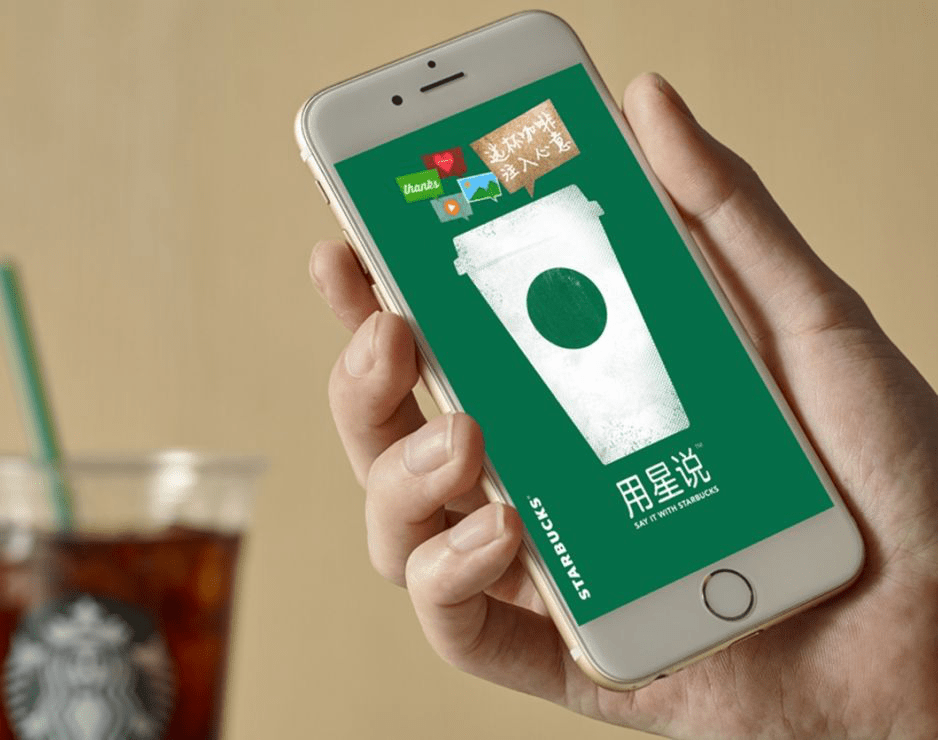
Starbucks has its own mobile application. The background data system of the application will continuously collect various data information of members, including basic information, preferences, consumption records, client usage habits, third-party data and scenario data. Data analysts will conduct in-depth analysis of user data to realize personalized marketing effectively combined with the scene. Starbucks China, in conjunction with social networking giant Tencent, has launched a small program called “Say it with Starbucks” on WeChat to strengthen user engagement. Each consumer can click to see the location of the nearest store, coupon information, and share it with WeChat friends (Stories.starbucks.com, 2017). This really enables customized push.
Module 4: Ordering

Although we are used to using mobile app to order meals now, it was not common in 2009. The Starbucks mobile card app, launched in September 2009, enables consumers to easily manage their Starbucks cards via mobile devices. With the Starbucks mobile card app, customers can reload their card balance directly from their smart phone, check the status of Starbucks bonus, find the nearby Starbucks store, and realize mobile ordering. In this way, users in a hurry do not need to wait in line, thus saving time. Starbucks has also cooperated with Uber (Chickowski, 2019). Users can directly enter Uber taxi interface through Starbucks app. This further enhances the user experience. In China, Starbucks and Alibaba have reached cooperation to provide “Starbucks Delivers” services in 35 cities. Starbucks also shares its membership system with Eleme, a “take out” mobile app owned by Alibaba Group. Users can also accumulate Starbucks membership points when placing an order in Eleme. Starbucks launched the “Starbucks Now” service, which realized the pre-order service of placing an order with mobile phone and getting it from the store (Gustafson, 2019). On the way to work, customers can order Starbucks coffee near the office building and pick it up at the store, which saves the time of queuing and waiting for production.
Starbucks is turning a profit by executing its innovation strategy with digital flywheels. In fiscal 2018, its revenue grew to $24.7 billion (Chickowski, 2019). Meanwhile, in the first quarter of fiscal 2019, the company’s revenue grew by 9%, and its stock price has been rising steadily. At the 2018 shareholder meeting, current CEO Johnson identified the digital flywheel as one of the three strategic business initiatives that have propelled Starbucks forward. There is no doubt that the digital flywheel, a digital business model, has made a great contribution to Starbucks.
Reference:
Chickowski, E. (2019). Starbucks’ Digital Flyweel Strategy Continues to Pay Off – Digirupt.io. [online] Digirupt.io. Available at: https://digirupt.io/starbucks-digital-flyweel-strategy-continues-to-pay-off/.
Dignan, L. (2017). Starbucks to step up rollout of ‘digital flywheel’ strategy | ZDNet. [online] ZDNet. Available at: https://www.zdnet.com/article/starbucks-to-step-up-rollout-of-digital-flywheel-strategy/.
Gustafson, I. (2019). Starbucks Introduces New ‘Starbucks Now’ Retail Experience – CStore Decisions. [online] CStore Decisions. Available at: https://cstoredecisions.com/2019/07/31/starbucks-introduces-new-starbucks-now-retail-experience/.
Starbucks China. (2020). Starbucks Rewards™ – Earn Stars for Rewards. [online] Available at: https://www.starbucks.com.cn/en/account/starbucks-rewards/.
Statista. (2020). Starbucks: number of stores in China 2018 | Statista. [online] Available at: https://www.statista.com/statistics/277795/number-of-starbucks-stores-in-china/.
Stories.starbucks.com. (2017). Starbucks. [online] Available at: https://stories.starbucks.com/press/2017/starbucks-partners-with-weixin-to-launch-social-gifting-in-china/.
Zhou, K. (2017). Alipay is now available at all Chinese Starbucks stores – Pandaily. [online] Pandaily. Available at: https://pandaily.com/alipay-is-now-available-at-all-chinese-starbucks-stores/.
 BEMM129 Digital Business Models